


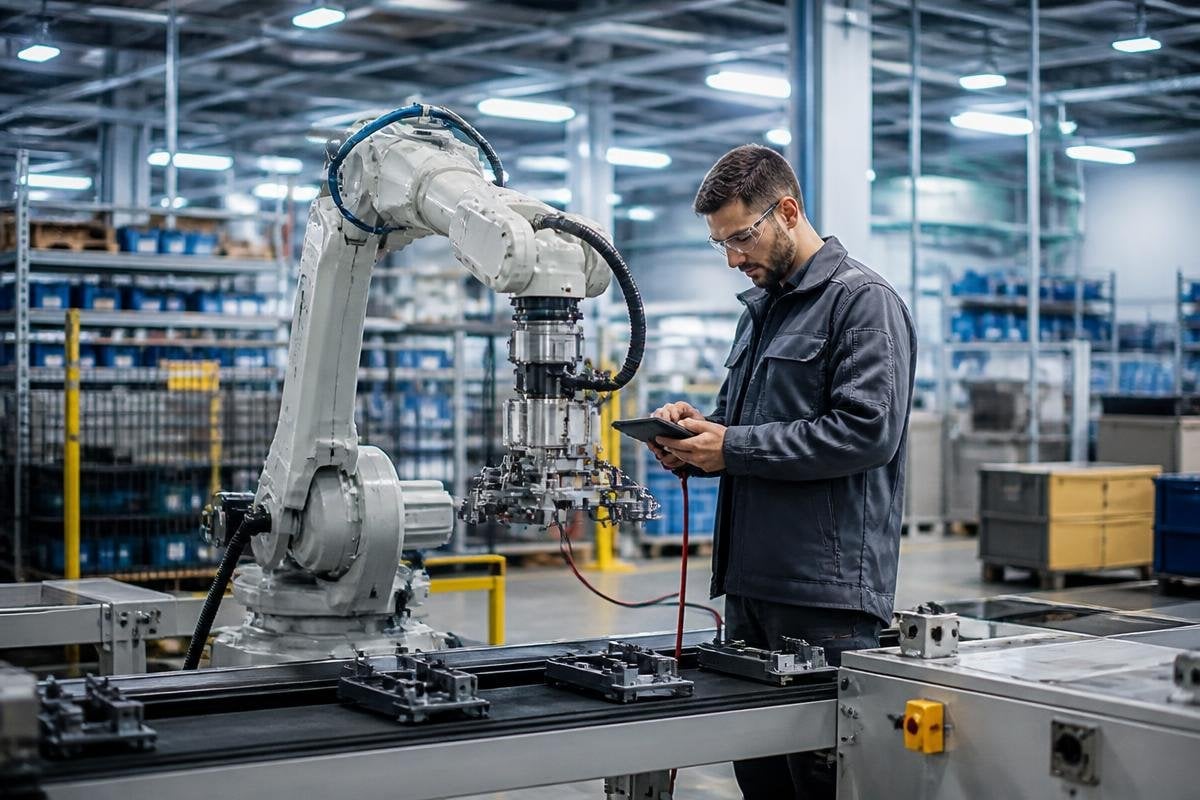
A trillion-dollar robotics industry would need to earn money from machines, software, parts, services, and the work built around them. Robot sales alone are unlikely to carry that figure, especially when many systems still need people for setup, repair, supervision, and safety checks.
The useful question for an operations manager is narrower: which jobs can a robot do often enough, safely enough, and at a cost that makes sense?
- More machines: factories, warehouses, farms, hospitals, and public sites would all need repeatable robot tasks.
- More revenue per machine: service contracts, spare parts, software, and training would count alongside the sale.
- More proof: buyers would need records for uptime, payload, runtime, repair time, and worker safety.
Where the money could come from
Several revenue streams can support a robot. The sale is the first payment. A company may also pay for installation, software updates, remote help, replacement parts, and scheduled service.
That model works best when the robot does one task for long periods. A mobile robot moving bins can be judged by completed trips, stopped trips, charging time, and help requests. An inspection robot can be judged by the number of checks it completes and the faults it finds.
The same rule applies across robotics. A machine needs a clear job and a result that a buyer can count. “Uses artificial intelligence” says little until the buyer can see what the system does during a shift.
A large industry would also need companies that make motors, cameras, grippers, batteries, safety systems, control software, and repair tools. Those suppliers may earn money even when the final robot maker sells only a small number of machines.
The work has to fit the machine
Robots perform best when the work stays within known limits. A factory arm may repeat the same motion thousands of times. A delivery robot may handle a mapped route. A research machine may work well in a test room but need a person when lighting, floor surfaces, or object shapes change.
That gap matters to the buyer. A robot that runs for two hours before charging has a different business case from one that runs through a full shift. A gripper rated for a certain payload cannot be judged by its appearance. The number is what matters.
Safety adds another cost. A site may need fencing, sensors, marked routes, emergency stops, staff training, and a process for restarting the robot after a stop. Those parts may decide the price of a deployment before the robot reaches the work area.
A trillion-dollar forecast needs more than a unit price. Robot 24 lets you compare that forecast with dated machine prices, deployment sites, and task results. The gap between robots doing paid work and sales plans on paper will shape the market’s real size.
What could hold the market back
The hardest limit is often the work around the robot. Someone still has to map the site, load the right software, check failed tasks, replace worn parts, and decide when a human should take over.
Data can also be thin. A short video may show a successful pick, but it may not show how many attempts failed, how long setup took, or what happened after the camera stopped recording. Buyers need those details before they can compare one system with another.
Prices create another test. A robot with a low purchase price may need extra sensors, a special gripper, a network upgrade, or a full-time supervisor.
A higher-priced system may cost less to run, but that claim needs figures for uptime, service hours, energy use, and repair time.
I would treat any trillion-dollar forecast as a model to test, not a fact to repeat. The number only matters after the work, cost, and service burden are measured.
A buyer’s check before the forecast
Use these questions when a robotics company presents a large market figure:
- Name the task: What exact job does the robot do, and how often does it repeat that job?
- Check the result: Which number proves value: completed units, inspection findings, travel distance, or reduced stoppage time?
- Count the people: How many staff hours go into setup, supervision, recovery, cleaning, and repair?
- Price the full site: Add the robot, tooling, safety hardware, software, training, power, and service.
- Ask for the missing record: Request uptime, failed-task rate, average repair time, and the period used to measure them.
A trillion-dollar industry becomes possible when these figures hold across many jobs and sites, not when a forecast grows by itself. The next useful proof is a paid deployment with clear task data, full costs, and results that a buyer can check.
